 > Legal Topics > Family and Relationships > Child Support > General Information
 When Does Child Support End?
To find out when child support will end, look at your most recent child support order. It may include a specific date, such as the child’s 18th birthday, or a specific event, such as the child’s graduation from college, that will end the child support obligation. If your child support is collected and enforced through the Probation Division, they will stop collecting support on that date unless another order changes that date.
If DYFS or DCPP secured a child support order against you when your child was in foster care, be aware that a law change in 2025 eliminated almost all foster care child support. If you are still being impacted by foster care child support owed to DCPP, read Frequently Asked Questions regarding the Equitable Outcomes in Child Support Collection Act to learn how to get relief from support, judgments, or warrants.
When may a parent ask the court to emancipate the child and stop child support?
A parent may make a motion or an application to declare a child emancipated and end child support when the child is no longer “in the sphere of influence” of the parent. Generally, this means when the child reaches the age of 18 and is no longer in school, so long as the child is not disabled and dependent upon the parents. If a child reaches 18, is no longer in high school, and has no plans to attend college or a job-training program, the parent obligated to pay child support can ask the court to declare the child emancipated and end child support. The case for emancipation is stronger if the adult child has moved out of the custodial parent’s home and obtained employment.
Should I file a motion or an application with the court?
A “motion” and an “application” are different sets of forms filed with the court to change or stop child support. Which set of forms you will file depends upon which type of court case you have. If the two parents have a divorce, civil union dissolution, or domestic partnership termination (collectively referred to as a “dissolution” matter), the parent will file a motion to modify child support. If the parents do not have one of those types of cases, or if the case involves a non-parent caregiver (such as a grandparent as the custodian), the case is called a “non-dissolution” matter, and the party will file an application to modify child support.
Still not sure? Every case has a unique docket number assigned by the court when the case is initially filed. The first two digits of the docket number identify which type of case it is. You can use those two digits and the chart below to figure out whether you need to file a motion or an application. Both sets of forms are available on the court’s website.
To file an application: How to File a Request to Modify a Non-Dissolution "FD" Court Order Previously Issued By the Court
To file a motion: How to Ask the Court to Change/Enforce an Order in Your Case, or Request Another Related Action in Your Case
|
Case Type |
Docket # Begins |
File Type |
|---|---|---|
|
Divorce |
FM |
Motion |
|
Dissolution of Civil Union |
FM |
Motion |
|
Termination of Domestic Partnership |
FM |
Motion |
|
Child Abuse or Neglect |
FN |
Motion |
|
Guardianship/Termination of Parental Rights |
FG |
Motion |
|
Domestic Violence |
FV |
Application |
|
Non-Dissolution |
FD |
Application |
What happens if none of the previous situations apply?
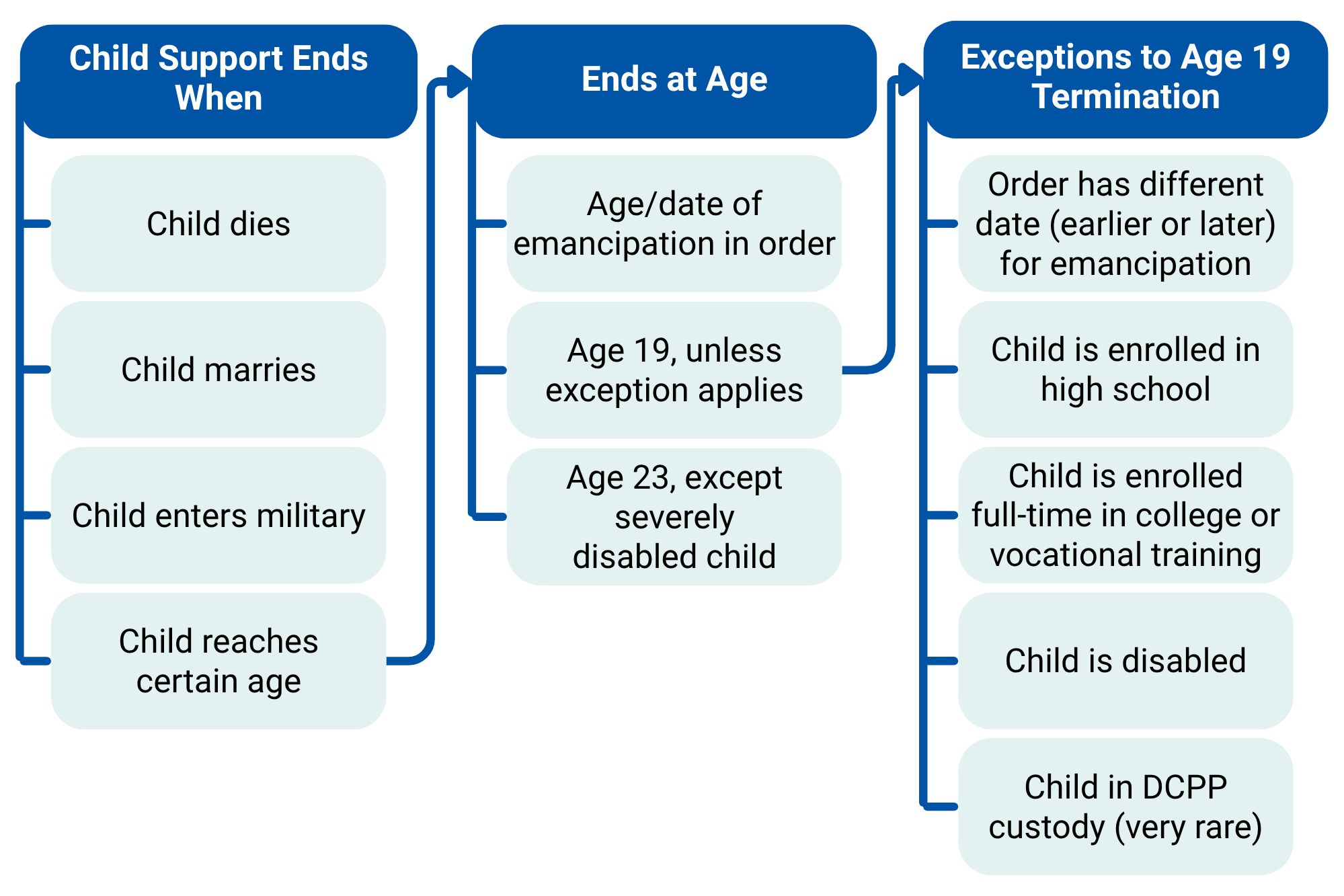
New Jersey’s child support termination statute (N.J.S.A. 2A:17-56.67 to 56.73) allows for child support to end without either party having to formally ask the court to end the child support. This law says that child support will stop automatically when the child:
- Dies
- Marries
- Enters the military services
- Reaches the age of 19, unless an exception applies.
What are the exceptions to child support automatically stopping at age 19?
Child support may continue past the age of 19 if:
- A court order requires a different age or date for child support termination.
- The child is still enrolled in high school.
- The child is enrolled full-time in college or vocational school.
- The child is severely disabled and dependent upon the parents.
- The child is in the custody of DCPP (formerly DYFS). In this case, child support may continue to age 21 (but the law now permits child support to be paid to DCPP only in rare situations).
What will happen when my child turns 19?
If your child support case is collected and enforced through New Jersey’s Probation Division, they will send a notice of proposed termination of child support to both parents (or other person with custody) six months before the child turns 19. The notice will also include special forms needed to request a continuation of child support beyond the child’s 19th birthday. A second notice regarding the proposed termination of child support, forms, and directions on requesting a continuation will be sent three months before the child turns 19.
How do I request continued support after age 19?
If one of the exceptions applies, the custodial parent may file a written request for continuation of child support. The request must include the forms provided with the notice and evidence of the exception. The evidence must include at least one of the following:
- A court order stating a different date or age when child support ends.
- A letter from the child’s high school stating the child remains enrolled, with an expected graduation date.
- A letter from the child’s college or vocational school stating that the child is enrolled full-time and the expected graduation or completion date.
- A notice from a state or federal agency (such as Social Security or the Division of Developmental Disabilities) stating that the child has been found to be disabled.
The written request for continuation must be received at the address directed at least 45 days before the child’s 19th birthday. To determine the 45-day deadline, count all days, including weekends and holidays.
What happens after a written request for continuation is sent?
Probation will review the forms and evidence and make a recommendation to a judge to either terminate or continue support on the child’s 19th birthday. If the judge continues support, they will set a new date to terminate child support (such as the expected graduation date). No additional notice will be provided. When the new termination date arrives, child support collection and enforcement will stop, unless a new motion or application to continue support is filed and granted.
Note: There is no option for the non-custodial parent to see the written request for continuation or respond to it directly. Once the court enters an order terminating or continuing child support, either parent may file a motion or application with the court to request a full court hearing, where both parents will have a chance to present evidence and challenge the other parent’s evidence.
If there is no request for continuation, or the court does not grant a continuation, a judge will issue an order terminating the support obligation as of the child’s 19th birthday and send the order to both parents (or other parties to the case).
|
6 months before child turns 19 |
3 months before child turns 19 |
45 days before child turns 19 |
On or before child turns 19 |
|
FIRST NOTICE |
SECOND NOTICE |
DEADLINE TO FILE |
ORDER |
What if I disagree with the court order?
If either parent (or party) disagrees with the court order entered, they may request a hearing to present witnesses and evidence on the issues of termination, continuation, or modification of support.
What if child support is still owed when the child support order is terminated?
Once a child support order is terminated, any support that is due at the time the order is terminated remains due and owing. The old support is called “child support arrears.” Probation will maintain an open file for the child support arrears. It will not add any new support to the account, but will continue to collect and enforce child support arrears until they are paid in full.
Example: Ms. Brown pays the father of their one child $100 weekly in current support and $20 weekly toward child support arrears. Ms. Brown owes $1,500 in child support arrears. When their child support is terminated, the new order will require Ms. Brown to pay no current support payment, but $120 weekly toward arrears through Probation until the back support is paid in full.
What if the original order includes more than one child?
If, upon termination of child support for one child, there are other children remaining on the child support order, the court order terminating support will also set the child support award for the remaining children. However, it will set the new award at the same amount as the pre-termination award, which may be more than what is normally required for one child. To request to lower the child support based upon the termination of support, the non-custodial parent MUST file a motion or application to reduce child support. The court may recalculate the child support guidelines and set a new child support amount for the remaining children on the order. The motion or application to reduce child support should be made before or soon after the termination of child support.
Example: Mr. Patel-Rodriguez pays his ex-wife, Ms. Patel-Rodriguez, $100 weekly in current child support plus $20 weekly toward child support arrears, totaling $120 weekly for their two children. When one child turns 19, and there are no exceptions that apply, the child support for that child will terminate. Going forward, the new order will be $100 weekly for current child support and $20 weekly toward child support arrears, totaling $120 weekly. This is more than the New Jersey Child Support Guidelines would require for one child, and the termination of child support for one child is a substantial change in circumstances. Mr. Patel-Rodriguez would need to file a motion or application to reduce the child support by recalculating the child support under the guidelines.
Can I increase the child support arrears payments?
When there are no children left on the order after termination, but child support arrears are still owed, the termination order will result in an arrears-only payment. The new arrears payment will equal the amount that was ordered for current and arrears payment before termination. If that amount seems small in comparison to the amount of arrears owed, the custodial parent may make a motion or application to increase the arrears payment amount.
How long can child support continue?
The child’s 23rd birthday is the limit on when child support may be collected, except for a severely disabled dependent adult child, who can continue to receive child support as long as they remain disabled and dependent.
What if the child is still in school even after their 23rd birthday?
If a child remains in school after their 23rd birthday, the court may (but is not required to) order ongoing financial maintenance from the non-custodial parent, but it will not be called “child support.” This is important for a few reasons: 1) The Probation Division will not collect or enforce “financial maintenance” for a dependent adult child. 2) A new order must be entered requiring the non-custodial parent to pay “financial maintenance.”
How do I get financial maintenance for my dependent adult child?
For a dependent adult child or a child still in school, child support may be continued up to his or her 23rd birthday. On or before that date, the custodial parent should file a motion or application for financial maintenance and/or school expenses for the dependent adult child. The motion or application must include evidence.
For a child still in school, the evidence should include a letter from the school verifying that the child is enrolled full-time. The motion or application should also include evidence of the current household expenses and the expenses of the dependent adult child. If the court awards ongoing financial maintenance, the court may elect to set financial maintenance at the same rate the child support was before it was terminated or set a new amount based on the current financial needs of the dependent adult child.
This information last reviewed: Mar 27, 2026

Legal Services of New Jersey
P.O. Box 1357
Edison, NJ 08818-1357
Contact Us
Statewide Legal Assistance Hotline
Call or apply online for free legal assistance:
1-888-LSNJ-LAW (1-888-576-5529)
www.lsnjlawhotline.org
Use of this website signifies your agreement to our Terms of Use and Privacy Policy